Table of Contents
- 1. Introduction — 30 Years in the Field
- 2. What Is Line Boring? The Simple Definition
- 3. What Is a Bore, and Why Does It Wear?
- 4. Line Boring vs Other Machining Processes
- 5. The Line Boring Process — Step by Step
- 6. What Tolerances Does Line Boring Achieve?
- 7. When Do You Need Line Boring?
- 8. On-Site Line Boring vs Workshop Line Boring
- 9. Line Boring Applications in India
- 10. How Much Does Line Boring Cost in India?
- 11. Frequently Asked Questions
- 12. References
1. Introduction — 30 Years in the Field
I have spent more than 30 years working with heavy equipment in India. In that time, I have seen what happens when a bucket pin bore wears out, when a crane boom pivot goes loose, when a crusher eccentric shaft housing starts to fail. The question that comes up repeatedly — from contractors, fleet managers, workshop owners, and equipment operators — is always the same: what exactly is line boring, and do I actually need it?
It is a fair question. Line boring is a term that gets used widely in heavy equipment maintenance circles but is rarely explained clearly. This guide gives you the complete answer — what line boring is, how it works, when you need it, what it costs, and how it is done on-site without sending your equipment to a workshop.
I am Pankaj Bhardwaj, Founder of PR Crane & Earthmovers and BOS — Bore On Site, Udaipur, Rajasthan. What follows is 30 years of field knowledge, explained plainly.
2. What Is Line Boring? The Simple Definition
Line boring is a precision machining process used to restore worn or damaged cylindrical bores in heavy equipment to their original diameter, roundness, and alignment.
The "line" in line boring refers to the axis — the centreline — of the bore being machined. A boring bar is aligned along this centreline and rotated while it advances through the bore, cutting material to restore the bore to the correct specification. The key is that the bar maintains alignment along the true centreline of the component, ensuring the repaired bore is concentric, round, and correctly positioned relative to the rest of the structure.
In practical terms for heavy equipment maintenance: line boring is what you do when an excavator bucket pin bore, a crane boom pivot, or a mining equipment joint has worn out of shape and needs to be restored so the machine works correctly again. It is the repair that brings a worn-out joint back to factory specification — without removing the component, without a workshop queue, and without days of machine downtime when delivered on-site by BOS.
3. What Is a Bore, and Why Does It Wear?
A bore is a cylindrical hole — machined to a precise diameter — through which a pin or shaft passes. On heavy equipment, pin-and-bore joints are the primary connection points between moving parts: between the boom and the arm on an excavator, between the arm and the bucket, between the swing bearing and the house, between a crane boom and its pivot structure.
These joints carry enormous loads. Every time an excavator digs, every time a crane lifts, every time a crusher processes rock — force passes through the pin-and-bore joint. The pin rotates and oscillates inside the bore. Over time, this repeated movement — combined with load, abrasion from contaminated grease, and the inevitable presence of fine particles in Indian field conditions — causes the bore to wear.
The bore loses its circular shape. It becomes oval — worn more on the loaded face than the unloaded face. The pin develops play inside it. The joint becomes loose. Bucket control deteriorates. Strange knocking sounds appear during operation.
If left uncorrected, the wear accelerates: a loose pin transmits shock loads that the bore was never designed to absorb, wearing it faster with every cycle. See our full guide on excavator bucket pin bore repair →
Line boring is the repair that reverses this process — restoring the bore to its correct diameter and shape so the joint works as it was designed to work.
4. Line Boring vs Other Machining Processes
Line boring is often confused with related processes. Here is how it differs from each.
| Process | What It Does | Key Difference from Line Boring |
|---|---|---|
| Line boring | Restores existing worn bores to original diameter and alignment | Works on worn bores in-situ; maintains centreline alignment through the component |
| Standard boring | Enlarges a hole to a new, larger diameter | Does not restore original spec; used in new fabrication or where oversize pins are acceptable |
| Drilling | Creates new holes in solid material | Line boring works on existing holes only — it is a restoration process, not a hole creation process |
| Honing | Improves surface finish of an already-accurate bore | Does not correct diameter or alignment; used after boring for fine finish only |
| Reaming | Enlarges and finishes an existing hole to close tolerance | Small material removal only; cannot address significant wear depths |
| Reboring | General term for re-machining a bore, often used for engine cylinders | Line boring specifically refers to maintaining axial alignment across a pin-and-bore joint; reboring typically moves to a new oversize rather than restoring original spec |
The key distinction of line boring is the emphasis on alignment along the axis. When a pin joint has two bores — one on each side of the component — both bores must be concentric with the same centreline for the pin to fit correctly and the joint to carry load evenly. Line boring, by maintaining the boring bar along this centreline throughout the machining operation, ensures both bores are restored to the same axis. Standard boring operations do not guarantee this inter-bore alignment.
5. The Line Boring Process — Step by Step
Understanding the process demystifies line boring and helps equipment owners make informed decisions about when and how to use it. Here is what happens from start to finish.
Bore Assessment
Before any machining begins, the worn bore is measured. An internal bore gauge or dial calipers measure the bore diameter at multiple points around the circumference — typically at 0°, 45°, 90°, and 135° — and at multiple depths. This reveals how much wear has occurred, whether the bore is uniformly worn (round but oversized) or unevenly worn (oval), and how severe the damage is. This assessment determines what repair approach is needed and how long the job will take.
Bore Welding (Where Required)
In most heavy equipment bore repairs, the bore has lost too much material to be simply machined to a slightly larger diameter. The worn bore must first be built up with weld material — this is bore welding. A welding head deposits weld metal inside the bore to build the diameter back up to a weldable oversize. The type of welding depends on the wear pattern: inner circle welding for uniform full-circumference wear, sector welding for asymmetric one-sided wear (handled with precision by the BOS DS60's numerical control), or jump welding for partial bore wear. Bore welding is why the most useful machines are combined boring and welding machines — they perform both operations in a single setup without repositioning.
Cooling Period
After welding, the bore is allowed to cool. This is not an optional step. Boring into a hot weld deposit produces inaccurate results because the material contracts as it cools, changing dimensions after machining. Depending on bore size and ambient temperature, cooling time is typically 30 to 60 minutes. BOS technicians do not skip or rush this stage — it is non-negotiable for achieving the specified tolerance.
Boring Bar Setup and Alignment
The boring bar — a precision-ground alloy steel bar (40Cr/42CrMo) — is threaded through the bore from one side and supported by a bracket on the opposite side. Self-centering setup cones align the bar concentrically within the bore. Alignment is verified with a dial indicator. This alignment is the most critical step in the entire process: any deviation here produces a bore that is eccentric, oval, or misaligned with the opposite bore in the joint. Time spent on setup is never wasted.
Line Boring to Specification
The drive unit rotates the boring bar and advances it along the bore axis. The cutting insert removes material from the weld deposit until the bore reaches the original specified diameter. Spindle speed is typically 50 to 300 RPM depending on bore diameter and material. The boring head maintains the same centreline established during setup — ensuring the finished bore is concentric, round, and correctly aligned. On the BOS DS50, parameters are set manually; on the DS60, numerically — for consistent, repeatable output regardless of operator.
Final Measurement and Verification
After boring, the bore is measured again at the same points used during the initial assessment. Diameter, roundness, and coaxiality with the opposite bore are all verified. The replacement pin is fitted to check clearance. Only when measurements are within specification is the setup released and the equipment returned to service.
Total time on-site: A standard excavator bucket pin bore repair — assessment, welding, cooling, boring, and verification — typically takes 4 to 8 hours. The machine is back in production the same day. This compares to 5 to 10 days via the workshop route.
6. What Tolerances Does Line Boring Achieve?
A common concern among heavy equipment owners is whether line boring — particularly portable on-site line boring — achieves the precision standards that heavy equipment requires. The answer is yes, when the work is performed with correctly calibrated equipment and a skilled operator.
| Measurement | BOS Achievement (On-Site) | Standard Required (H7 Fit) |
|---|---|---|
| Bore diameter tolerance | ±0.05mm | H7 tolerance class |
| Circularity (roundness) | 0.03–0.05mm TIR | <0.05mm TIR |
| Coaxiality (inter-bore alignment) | ±0.1mm per 500mm of bar length | <0.15mm per 500mm |
| Surface roughness | Ra 3.2 micrometres | Ra 3.2–6.3 for pin bore applications |
| Bore straightness | Within 0.05mm over bore length | Equipment-specific |
Source: ISO 286-1 Geometrical Product Specifications; BOS field service records 2020–2026
These tolerances match H7 fit requirements for heavy equipment pin joints — the same standard that original equipment manufacturers specify for new equipment. A correctly performed line boring repair restores the bore to new-equipment specification, not a compromised approximation of it.
The single-setup approach used in on-site line boring — welding and boring without repositioning the bar — can actually produce better inter-bore alignment than a workshop approach where the component is removed and set up twice. Alignment error does not accumulate in a single-setup sequence.
7. When Do You Need Line Boring?
Line boring is needed when a pin bore has worn beyond the point where a simple pin and bushing replacement can restore correct joint function. Here are the specific situations that call for it.
| Symptom | What It Means | Action Required |
|---|---|---|
| Visible pin movement when bucket is lifted | Bore worn well beyond pin clearance tolerance | Line boring — repair soon |
| Knocking or clunking during movement | Pin rocking in oversized bore under load | Line boring — inspect immediately |
| Attachment drifting under hydraulic load | Bore so worn that position control is compromised | Line boring — safety concern |
| Grease purging rapidly or not holding | Bore gap allowing grease to escape and contamination to enter | Line boring likely — assess bore clearance |
| Uneven or one-sided movement of attachment | Asymmetric bore wear — more advanced stage | Line boring with sector welding — DS60 recommended |
| Pin replacement not resolving looseness | Bore itself is oversized — new pin has same problem | Line boring required before pin replacement |
| Scheduled maintenance finds bore oversize | Proactive catch before symptoms develop | Line boring — plan at next convenient downtime |
8. On-Site Line Boring vs Workshop Line Boring
Line boring can be performed in two ways: by taking the component to a machine shop workshop, or by bringing a portable line boring machine to the equipment on-site. For the vast majority of heavy equipment bore repairs in India, on-site line boring is the superior choice.
The workshop route requires removing the worn component — bucket, arm, boom section, or crusher housing — from the machine, arranging transport to a machine shop, waiting for the job to be scheduled and completed, transporting the component back, and reassembling. This process takes 5 to 10 days in most practical scenarios in India, during which the machine is completely idle.
The on-site route requires transporting a portable line boring machine to the site. The boring bar is set up at the worn bore without removing the component from the machine. Welding and boring are completed in a single session. The machine is back in operation the same day or the following morning.
The quality argument for workshop repair — that workshop machines produce more accurate results — does not hold in practice. Portable line boring machines such as the BOS DS50 and BOS DS60 achieve the same diameter tolerances and surface finish as workshop machines. The single-setup approach used in on-site repair (welding and boring without repositioning) can actually produce better inter-bore alignment than a workshop approach where the component is set up twice.
For equipment on remote sites — mining operations, highway projects, dam construction — the workshop option may not be practical at all. On-site line boring is not a compromise in this scenario. It is the only sensible repair strategy. See our complete guide to on-site line boring service across India →
| Factor | On-Site Line Boring (BOS) | Workshop Line Boring |
|---|---|---|
| Machine downtime | 4–8 hours | 5–10 days |
| Component removal required | No — bar set up in-situ | Yes — full disassembly and transport |
| Transport cost | Nil | Both ways — Rs. 8,000–25,000 |
| Alignment accuracy | Single setup — no repositioning error | Two separate setups — error can accumulate |
| Service fee | Rs. 8,000–25,000 per bore | Rs. 25,000–80,000 per bore |
| Transit damage risk | None | Present on every transport trip |
| Suitable for remote sites | Yes | Often impractical |
9. Line Boring Applications in India
Line boring applies across the full range of heavy equipment operating in Indian construction, mining, infrastructure, and industrial sectors.
Construction & Earthmoving
Excavator bucket pin bores, boom-to-arm pivot bores, arm-to-bucket bores, swing bearing housings, blade pivot bores on motor graders, lift cylinder bores on dozers. These are the highest-volume line boring applications in India, driven by the country's 95,000+ active excavator fleet. Construction & Earthmoving applications →
Mining
Mining excavators (20T to 100T+), rope shovels, draglines, jaw and cone crushers, dump trucks, and haul trucks. Mining applications involve larger bore diameters, more abrasive conditions, and more complex wear patterns — making the advanced welding modes of the BOS DS60 particularly valuable. Mining applications →
Cranes & Lifting Equipment
Crane boom pins, slewing ring housings, jib pivot bores, and outrigger bores. Cranes develop asymmetric bore wear due to consistent one-direction loading during lifts. Sector welding on the DS60 is particularly effective for crane bore repair, depositing material precisely where it is needed rather than around the full circumference.
Marine & Shipbuilding
Stern tube bores, rudder pintle and gudgeon bores, port crane pedestal bores, and propeller shaft bearing housings. On-site marine bore repair can eliminate the need for dry-docking in many cases. Marine & Shipbuilding applications →
Industrial Plant
Steel plant machinery, thermal power plant components, sugar mill equipment, paper mill machinery — any industrial equipment with large bearing housings or shaft journals that wear in service. In-situ repair without dismantling large production equipment is particularly valuable where downtime affects entire production lines.
10. How Much Does Line Boring Cost in India?
The cost of line boring in India depends on several variables.
Bore Diameter
Larger bores require more weld material and longer machining time. A 60mm bucket pin bore is significantly cheaper to repair than a 300mm crusher eccentric bore. Expect pricing to scale with bore diameter.
Wear Severity
A bore worn 1–2mm oversize requires one weld pass and typically completes in 4–5 hours. A bore worn 6–8mm oversize requires multiple passes, takes 8–12 hours, and costs proportionally more. This is the strongest argument for early intervention — bore repairs caught early cost a fraction of repairs left until they are severely worn.
Welding Mode
Standard inner circle welding is the most time-efficient mode. Sector and jump welding on the BOS DS60 require additional parameter setup time but produce better results for complex wear patterns.
Mobilisation and Volume
On-site service includes a mobilisation cost based on site distance from the BOS base in Udaipur. Multi-bore visits reduce the per-bore mobilisation cost significantly — fleet operators scheduling multiple bores in a single visit get substantially better value than single emergency call-outs.
Workshop vs On-Site Service Fees
Workshop line boring service fees typically run Rs. 25,000 to Rs. 80,000 per bore. BOS on-site service fees run Rs. 8,000 to Rs. 25,000 per bore. The on-site rate does not include the Rs. 1,75,000 to Rs. 3,50,000 in production losses that the workshop route incurs through machine downtime.
Owning a BOS Machine In-House
For operators considering purchasing a machine to perform line boring in-house: the BOS DS50 is priced at approximately Rs. 3,25,000 and the DS60 at approximately Rs. 5,75,000. At Rs. 8,000–25,000 per bore repair, a machine doing 20–30 repairs per month pays for itself in 3–6 months of operation. Compare DS50 vs DS60 to find the right machine for your work →
11. Frequently Asked Questions
12. References
1. ISO 286-1 — Geometrical Product Specifications: Limits and fits (H7 tolerance system)
2. Caterpillar Inc. — Excavator Operation and Maintenance Manual — pin joint service standards and bore tolerances
3. Komatsu — Equipment maintenance specifications for bucket pin joint clearance tolerances
4. Hitachi Construction Machinery — Undercarriage and attachment maintenance documentation
5. Bailey Heavy Equipment Repair Inc. — What is Line Boring? (bherinc.com, 2025)
6. Shingare Industries — Line Boring Machine On-Site Machining Guide (tubecleaner.co.in, 2025)
7. PR Crane & Earthmovers / BOS — Bore On Site: 30+ years field service data, Udaipur, Rajasthan
BOS delivers on-site line boring across India — same-day response for breakdown calls, scheduled service for planned maintenance. Contact the team to book a site assessment.
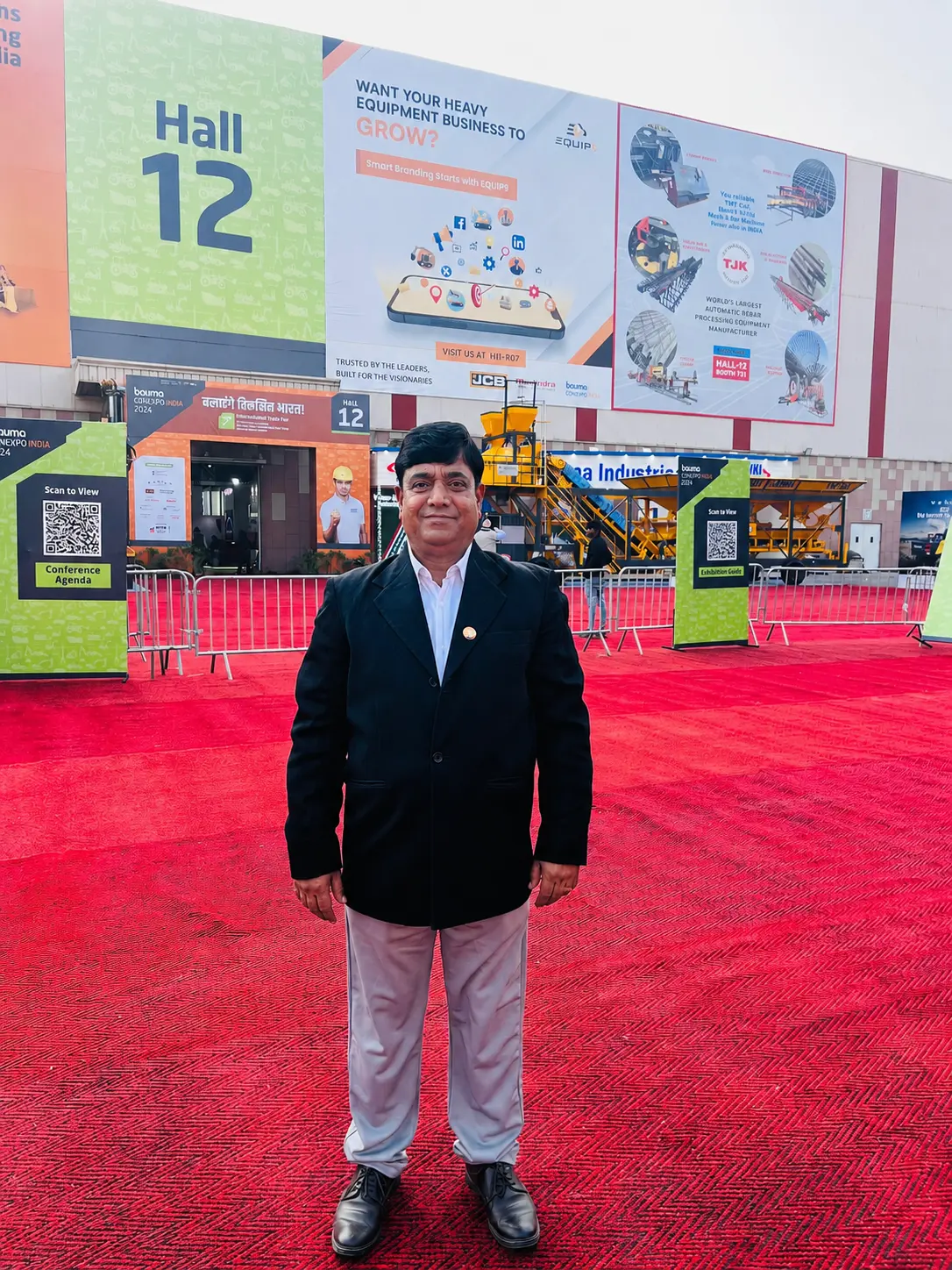
Pankaj Bhardwaj founded PR Crane & Earthmovers in Udaipur, Rajasthan, more than 30 years ago. BOS — Bore On Site grew from three decades of hands-on heavy equipment repair experience across India's construction, mining, marine, and industrial sectors. All technical content reflects field knowledge from real service operations.
wearebos.in