Table of Contents
- 1. Introduction — Why We Built BOS
- 2. What Is On-Site Line Boring Service?
- 3. When Do You Need On-Site Line Boring Service?
- 4. Equipment BOS Services On-Site Across India
- 5. How BOS On-Site Line Boring Service Is Delivered
- 6. On-Site vs Workshop — The Cost Reality
- 7. Why BOS / PR Crane & Earthmovers
- 8. Bore Repair Tolerances — What BOS Achieves On-Site
- 9. Pricing — What On-Site Line Boring Service Costs in India
- 10. Frequently Asked Questions
- 11. References
1. Introduction — Why We Built BOS
My name is Pankaj Bhardwaj. I founded PR Crane & Earthmovers in Udaipur, Rajasthan, more than 30 years ago, at a time when heavy equipment maintenance in India meant one thing: dismantle the component, put it on a truck, and send it to a machine shop — and hope it came back quickly.
It rarely did. And while it was away, the excavator sat idle. The crane stood still. The mining project fell behind. The contractor paid for equipment that was not working — and sometimes paid penalty clauses for delays on top of it.
That is why we built BOS — Bore On Site. The premise was simple: bring the line boring service to the equipment, not the other way around. Thirty years of field experience in heavy equipment repair across Rajasthan and beyond told us that the answer to bore wear was not a better workshop. It was a better way of working — on-site, in-time, without transport, without waiting.
This is a guide to what professional on-site line boring service looks like, when you need it, what it costs, and how it is delivered across India by BOS — the portable line boring service operated by PR Crane & Earthmovers, Udaipur.
2. What Is On-Site Line Boring Service?
On-site line boring service is the delivery of precision bore repair — welding and machining — directly to your equipment, at your project site, mine, port, or workshop. No component removal. No transport. No workshop queue. The line boring machine and the operator come to where the equipment is sitting.
The service covers two operations performed in a single setup:
- Bore welding — depositing weld metal inside the worn bore to build the diameter back up to a weldable oversize. This is the rebuilding phase: adding material where wear has removed it.
- Line boring — machining the weld deposit back to the original specified bore diameter, with correct surface finish and tolerance. This is the precision phase: restoring the bore to the dimension and geometry the manufacturer intended.
Both operations are performed without moving the boring bar setup between them. The alignment established at the start is maintained through both weld and bore phases — which is why on-site line boring consistently produces bore geometry that matches or exceeds workshop repair quality.
BOS uses two portable line boring machines for service work: the BOS DS50 for standard construction equipment bore diameters (55–300mm), and the BOS DS60 for larger mining, crane, and marine applications (65–600mm with numerical welding control). Read the full DS50 vs DS60 comparison →
3. When Do You Need On-Site Line Boring Service?
Bore wear on heavy equipment follows a predictable pattern. The earlier it is caught and repaired, the faster and cheaper the repair. The later it is left, the more complex and expensive it becomes. Here are the situations that call for on-site line boring service.
| Situation | What Is Happening | Urgency |
|---|---|---|
| Visible play in pin joint | Bore worn beyond pin clearance tolerance. Pin rocks in bore under load. | High — repair within days |
| Knocking or clunking during operation | Pin movement inside oversized bore creating impact load on each cycle. | High — inspect immediately |
| Bucket or attachment drifting | Bore so worn that hydraulic precision is compromised. Affects control and safety. | High — safety concern |
| Grease not holding / rapid purging | Bore gap allowing grease to escape; contamination entering joint. | Medium — accelerating wear |
| Uneven or asymmetric movement | One-sided bore wear — more advanced, requires sector welding. | Medium — catch before it worsens |
| Scheduled fleet maintenance | Proactive bore inspection revealing wear within repair range. | Low urgency — plan and schedule |
| Post-impact or shock load event | Sudden overload may have distorted bore geometry. | Inspect immediately |
A bore caught at the grease-purging stage costs a fraction of a bore left until the knocking stage. Early intervention is always the lower-cost decision.
4. Equipment BOS Services On-Site Across India
BOS on-site line boring service covers the full range of heavy equipment operating in Indian construction, mining, infrastructure, and industrial sectors. If it has a pin bore that wears, BOS can repair it on-site.
Construction & Earthmoving Equipment
Excavators of all sizes — from mini excavators to 50T+ machines — are the most common application. Bucket pin bores, boom-to-arm pivots, arm-to-bucket joints, swing bearing housings, and blade pivot bores on graders and dozers are all within BOS service scope. These are typically uniform wear patterns suited to the BOS DS50 for standard sizes, or the DS60 for larger excavators. See our Construction & Earthmoving applications page for the full scope.
Mining Equipment
Mining excavators (20T to 100T+), rope shovels, draglines, jaw crushers, cone crushers, dump trucks, and haul trucks all develop bore wear under the high-cycle, high-load, abrasive conditions of open-cast mining. Mining bore repair typically involves larger bore diameters and more complex wear patterns — asymmetric and partial wear requiring the BOS DS60's sector and jump welding modes. BOS has extensive experience in mining bore repair across Rajasthan, Gujarat, and other mining-intensive states. Explore mining applications →
Crane & Lifting Equipment
Crane boom pins, slewing ring housings, jib pivot bores, and outrigger bores wear through asymmetric loading — the crane always lifts predominantly in one direction. This produces one-sided bore wear specifically addressed by sector welding on the BOS DS60. Crane bore repair is particularly high-value work because crane downtime in construction and port operations is extremely costly. See our guide on the real cost of heavy equipment downtime in India.
Marine & Shipbuilding
Stern tube bores, rudder pintle and gudgeon bores, anchor hawse pipe bores, and port crane pedestal bores are all within BOS service capability. Marine bore repair using the DS60 can be performed on board or at the shipyard without dry-docking in many cases, significantly reducing vessel off-hire costs. BOS serves ports and shipyards across India's west and east coasts. Marine & Shipbuilding applications →
Industrial & Processing Plant
Large industrial equipment — steel plant machinery, thermal power plant components, paper mill machinery, sugar mill equipment — all develop bore wear on bearing housings and shaft journals. In-situ repair without dismantling large production equipment is particularly valuable in plant environments where downtime affects entire production lines.
5. How BOS On-Site Line Boring Service Is Delivered
The BOS service delivery process is standardised across all equipment types and locations. Here is what to expect from a BOS on-site line boring service call.
Enquiry and Assessment (Same Day)
Contact BOS via wearebos.in or phone (+91 9901585506). Provide equipment type, bore diameter if known, and site location. For urgent breakdowns, BOS responds to enquiries the same day. For planned maintenance, we schedule a site visit at a time that minimises production disruption.
Site Visit and Bore Measurement
A BOS technician visits the site to measure the worn bore — diameter, ovality, wear depth, and wear pattern. This assessment determines which welding mode is appropriate (inner circle, jump, or sector), how many weld passes are required, and the total time estimate for the repair. The equipment does not need to be moved for this assessment.
Machine Mobilisation
The BOS portable line boring machine — DS50 or DS60 depending on bore diameter and repair complexity — is transported to the site. BOS operates from Udaipur, Rajasthan, and serves sites across Rajasthan, Gujarat, Maharashtra, Madhya Pradesh, and other states on request. Mobilisation time depends on site distance.
Setup and Alignment (30–60 Minutes)
The boring bar is aligned through the pin bore using self-centering setup cones. The drive unit is clamped to one side. Alignment is verified with a dial indicator. This single setup is maintained through both the welding and boring phases — no repositioning, no alignment error between operations.
Bore Welding (45 Minutes to 3 Hours)
Welding parameters are set on the machine control — manually on the DS50, numerically on the DS60. The selected welding mode deposits material inside the bore. On the DS60, sector welding deposits only on the worn face of asymmetric bores, reducing material consumption and heat input compared to full-circumference welding.
Cooling Period (30–60 Minutes)
The weld deposit is allowed to cool under controlled conditions. Boring into a hot weld deposit risks dimensional inaccuracy as material contracts during cooling. BOS technicians do not skip or rush this stage — it is non-negotiable for achieving the specified tolerance.
Line Boring to Specification (1–2 Hours)
Without disturbing the setup, the boring head is engaged. The bore is machined to the original specified diameter. Diameter tolerance: ±0.05mm. Surface roughness: Ra 3.2 micrometres. Both values meet H7 fit requirements for heavy equipment pin joints.
Verification and Handover
Final bore measurements are taken. Replacement pin is fitted and clearance checked. The BOS technician records the repair details — bore diameter before, bore diameter after, welding mode used, and date of repair. The equipment is ready to return to production.
Total time on-site: A standard excavator bucket pin bore repair — weld, cool, bore, verify — typically takes 4 to 8 hours from setup to handover, depending on bore size and wear severity. The equipment is back in production the same day.
6. On-Site vs Workshop Line Boring Service — The Cost Reality
The most common objection to on-site line boring service is the assumption that it costs more than workshop repair. In practice, the opposite is true when total cost is calculated correctly. Read our full analysis on the true cost of heavy equipment downtime in India.
| Cost Factor | On-Site Service (BOS) | Workshop Route |
|---|---|---|
| Equipment downtime (Est. Rs. 35K/day lost production) |
4–8 hours Rs. 17,500 – 35,000 |
5–10 days Rs. 1,75,000 – 3,50,000 |
| Transport cost (both ways) | Nil | Rs. 8,000 – 25,000 |
| Service fee | Rs. 15,000 – 60,000 | Rs. 25,000 – 80,000 |
| Contract penalty risk | Minimal — same/next day repair | High — 5–10 day delay |
| Transit damage risk | None | Present on every trip |
| Alignment accuracy | Single setup — no repositioning error | Two separate setups |
| Total estimated cost | Rs. 25,000 – 60,000 | Rs. 2,15,000 – 4,90,000 |
Estimates based on typical heavy construction equipment operations in India. Actual costs vary by machine size, site location, and contract terms.
On-site service costs 40–60% less than the workshop route when production loss, transport, and total repair time are included. For a fleet operator running multiple machines, this saving compounds significantly across an operating season.
This is not about cutting corners. Workshop-quality tolerances are achieved on-site through the same setup-to-bore sequence — with the added advantage that the component never leaves the machine and the alignment is established once, not twice.
7. Why BOS / PR Crane & Earthmovers
PR Crane & Earthmovers has been operating in the heavy equipment sector from Udaipur, Rajasthan, for more than 30 years. The BOS line boring service is not a new business venture — it grew out of three decades of hands-on experience with the equipment problems that Indian contractors, mining operators, and fleet managers face every day.
The BOS DS50 and DS60 machines are used in our own field service operations — not just sold to others. Every design decision is tested against real-world performance in Indian field conditions. A machine failure in the field is our problem, not the customer's.
PR Crane And Earthmovers is listed as a top-rated Line Boring Services supplier on IndiaMART, reflecting our consistent delivery and customer response record across years of service operations.
Pankaj Bhardwaj's 30 years in the earthmoving and heavy equipment sector means BOS technicians approach every bore repair with practical knowledge that comes from having seen every variation of wear, every equipment type, and every site condition that India's construction and mining sectors produce.
The DS60's numerical control and sector welding capability means BOS can address complex asymmetric wear patterns — not just simple uniform bore wear. This produces longer-lasting repairs that reduce the frequency of re-repair on high-cycle equipment. Compare DS50 vs DS60 →
The DS50 covers 55–160mm (up to 300mm with extension) for standard construction equipment. The DS60 covers 65–600mm for heavy mining, crane, and marine applications. Between the two machines, BOS covers the complete range of bore repair applications in Indian heavy equipment maintenance.
BOS operates from Udaipur and serves sites across Rajasthan, Gujarat, Maharashtra, Madhya Pradesh, and other states. For large fleet operators, BOS machines are also available for purchase so in-house teams can perform routine bore repairs independently.
8. Bore Repair Tolerances — What BOS Achieves On-Site
A common concern about on-site repair is whether field conditions allow the same precision as a workshop environment. The answer, with the correct machine and single-setup methodology, is yes.
| Measurement | BOS Achievement | Industry Standard (H7 Fit) |
|---|---|---|
| Bore diameter tolerance | ±0.05mm | H7 tolerance class |
| Circularity (roundness) | 0.03–0.05mm TIR | <0.05mm TIR |
| Coaxiality (alignment) | ±0.1mm per 500mm | <0.15mm per 500mm |
| Surface roughness | Ra 3.2 micrometres | Ra 3.2–6.3 for pin bores |
| Bore straightness | Within 0.05mm over length | Equipment specific |
Source: ISO 286-1 Geometrical Product Specifications; BOS field service records 2020–2026
These tolerances are equivalent to workshop machining standards. The single-setup approach — welding and boring without repositioning — is a key reason why on-site results consistently match workshop quality. When two setups are used (as in the workshop route), alignment error can accumulate between the weld and bore phases. The BOS approach eliminates this variable entirely.
9. Pricing — What On-Site Line Boring Service Costs in India
Pricing for on-site line boring service in India varies based on several factors. Being transparent about these factors helps you understand what you are paying for and compare quotes accurately.
Bore Diameter
Larger bores require more weld material and longer boring time. A 60mm bucket pin bore takes less time and material than a 200mm crusher eccentric bore. Expect pricing to scale with bore diameter. For buyers considering purchasing their own machine, see our line boring machine buyer's guide for India.
Wear Severity
A bore worn 1–2mm oversize requires one weld pass. A bore worn 5–8mm oversize requires multiple passes and significantly more time. Catching the repair early substantially reduces cost — this is the most controllable factor in service pricing.
Welding Mode Required
Standard inner circle welding is the most efficient mode. Sector and jump welding on the DS60 are more precise but take additional setup time for parameter programming. Complex wear patterns cost more than simple uniform wear.
Site Location and Mobilisation
Sites within close range of Udaipur have lower mobilisation cost than remote sites in other states. For large fleet operators with regular volume, BOS can establish ongoing service agreements that reduce per-job mobilisation cost significantly.
Number of Bores in One Visit
Multiple bores repaired in a single mobilisation significantly reduce the cost per bore. Fleet operators who schedule multiple repairs in one visit get substantially better value than operators who call for single emergency repairs.
Contact BOS for a site-specific quote: wearebos.in/contact or +91 9901585506.
10. Frequently Asked Questions
11. References
1. IndiaMART — Line Boring Services supplier listings, India (June 2026) — PR Crane And Earthmovers listed as top-rated supplier
2. PR Crane & Earthmovers — 30+ years field service records, Udaipur, Rajasthan
3. ISO 286-1 — Geometrical Product Specifications: Limits and fits (H7 tolerance system)
4. Caterpillar Inc. — Excavator Operation and Maintenance Manual — pin joint service standards
5. Komatsu — Equipment maintenance specifications for bucket pin joint clearance tolerances
6. BOS — Bore On Site field service data, 2020–2026
BOS serves sites across Rajasthan, Gujarat, Maharashtra, Madhya Pradesh, and other states. Same-day response for breakdown calls. Contact us to book a site visit or get a quote.
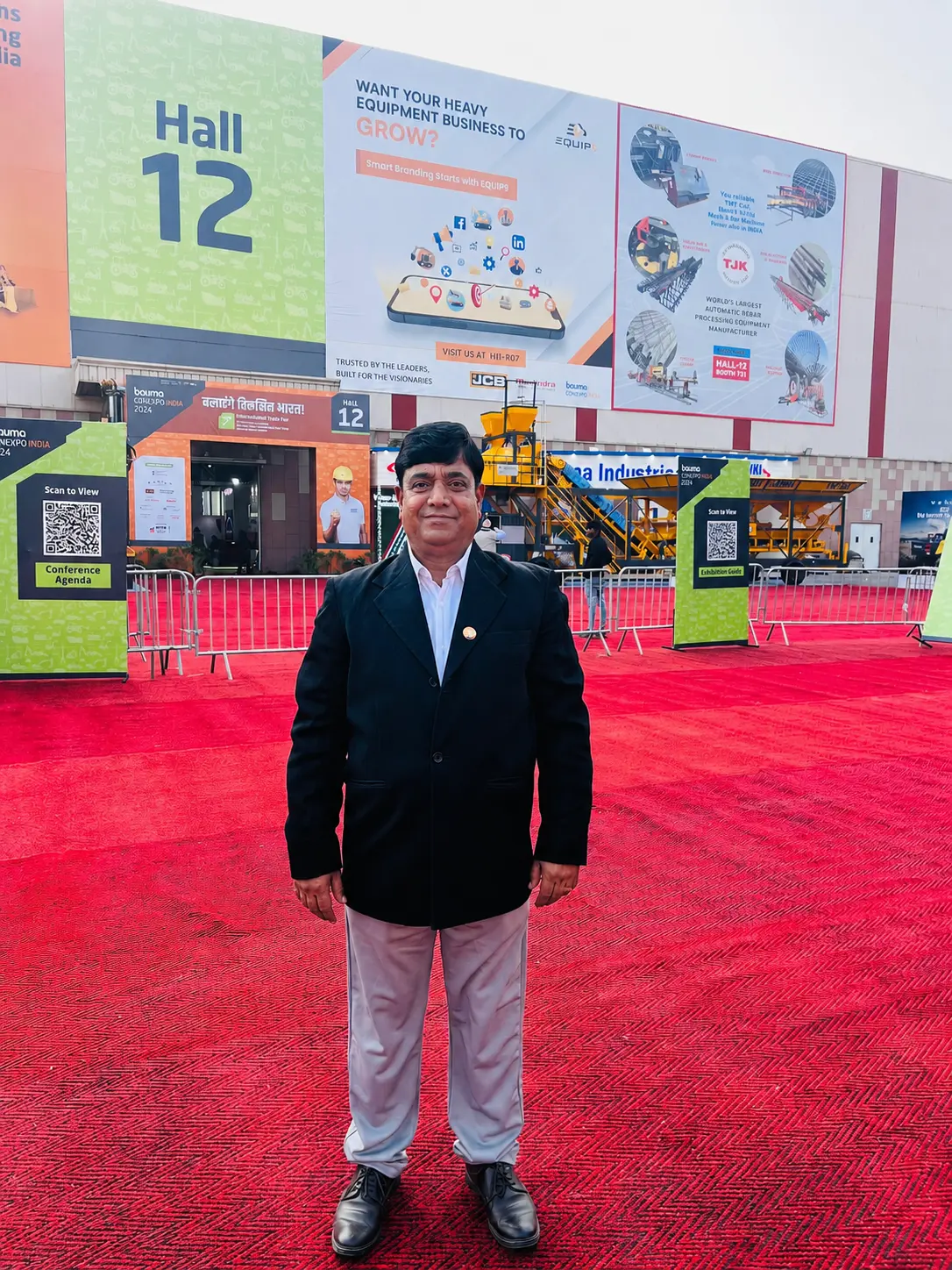
Pankaj Bhardwaj founded PR Crane & Earthmovers in Udaipur, Rajasthan, more than 30 years ago. BOS — Bore On Site is the portable line boring service that grew from three decades of hands-on experience with heavy equipment repair across India's construction, mining, and industrial sectors.
wearebos.in